
Can a Pill Replace Chemo for MET Exon 14 Lung Cancer? U.S. Targeted Therapy Explained for International Patients Seeking a Remote Second Opinion in U.S. (2026)

Updated: Jun 23
Introduction
A lung cancer diagnosis is overwhelming enough. Learning that your tumor carries a rare genetic change — a MET exon 14 skipping mutation — can make the path forward feel even more uncertain, especially when your local oncologist has limited experience with this specific alteration. But here is something important to know: for patients with MET exon 14 lung cancer, the treatment landscape has changed dramatically. In many cases, a once-daily oral pill can now replace standard chemotherapy — delivering meaningful tumor control with a more manageable side-effect profile.
This article explains what MET exon 14 lung cancer is, how targeted therapy works, which drugs are approved in the United States, and why consulting a U.S. lung cancer specialist — even from abroad — could significantly affect the quality of care you receive.
What Is MET Exon 14 Lung Cancer?
MET exon 14 skipping is a specific genetic mutation found in approximately 3 to 4 percent of non-small cell lung cancers (NSCLC), most commonly in the adenocarcinoma subtype. It occurs when a portion of the MET gene — exon 14 — is skipped during the process of building the MET protein. This causes the MET receptor to stay permanently "switched on," driving uncontrolled cancer cell growth.
This mutation tends to appear in older patients, often in their late 60s or 70s, and is more frequently seen in people who have never smoked or who were light smokers. Unlike EGFR or ALK mutations, MET exon 14 was historically harder to detect and lacked approved targeted treatments — until recent years changed that picture entirely.
Key facts about MET exon 14 lung cancer:
Found in 3–4% of NSCLC cases, making it relatively rare but not uncommon
Most common in older adults and those with limited smoking history
Requires specific molecular testing (not detected on standard pathology alone)
Associated with a distinct clinical profile and treatment response compared to other NSCLC mutations
Why Standard Chemotherapy Is Often Not the Best First Option
Traditional chemotherapy works by attacking rapidly dividing cells throughout the body — both cancerous and healthy ones. While it remains a valid option in many lung cancer situations, patients with actionable driver mutations like MET exon 14 skipping often respond poorly to chemotherapy alone and experience a heavier burden of side effects relative to the benefit achieved.
The shift in oncology thinking over the past decade has been decisive: when a tumor carries a targetable genetic driver, the standard of care is to match that driver with a drug designed specifically to block it. This approach — called targeted therapy — has transformed outcomes for patients with EGFR mutations, ALK rearrangements, and now, MET exon 14 alterations.
For patients with MET exon 14 lung cancer, using chemotherapy as a first-line treatment without first testing for this mutation — or without knowing that FDA-approved targeted options exist — may mean missing a more effective and better-tolerated treatment path.
FDA-Approved Targeted Therapies for MET Exon 14 Lung Cancer
Two MET inhibitors have received approval from the U.S. Food and Drug Administration (FDA) specifically for MET exon 14 skipping mutations in NSCLC: capmatinib (Tabrecta) and tepotinib (Tepmetko). Both are taken as oral tablets — once daily, at home. Neither requires hospital infusions.
Capmatinib (Tabrecta)
Capmatinib received full FDA approval based on the GEOMETRY mono-1 trial, which showed that patients with MET exon 14 skipping who were treatment-naïve (had not yet received chemotherapy) had an overall response rate of approximately 68%. Responses were durable, and side effects — while present — were generally manageable and distinct from the broader toxicities of chemotherapy. Common side effects include peripheral edema (swelling in the legs), nausea, and elevated creatinine levels.
Tepotinib (Tepmetko)
Tepotinib was approved based on the VISION trial, which demonstrated meaningful tumor shrinkage in both treatment-naïve and previously treated patients. The drug showed a response rate of around 46% across the overall cohort, with some patients maintaining responses for more than a year. Like capmatinib, tepotinib is an oral daily pill, and its most common side effects include peripheral edema, nausea, diarrhea, and fatigue.
Emerging Options: What Is on the Horizon
Beyond the two approved agents, research is actively ongoing. Savolitinib, a highly selective MET inhibitor, has shown promising results in clinical trials — particularly in Asian patient populations — and is being evaluated for broader approval. Additionally, next-generation MET inhibitors are being studied to address acquired resistance, which can develop after initial responses to capmatinib or tepotinib. Staying informed about the most current options requires access to specialists who are actively embedded in this clinical research ecosystem — something that U.S. academic cancer centers uniquely provide.
The Critical Role of Molecular Testing
One of the most important — and most frequently missed — steps in treating MET exon 14 lung cancer is proper molecular testing. This mutation is not detected on standard imaging or routine biopsy pathology. It requires comprehensive genomic profiling, also called next-generation sequencing (NGS), which analyzes the tumor's DNA to identify specific mutations, including MET exon 14 skipping.
Unfortunately, access to comprehensive NGS testing varies significantly by country and institution. In some regions, only partial panels are run, or MET exon 14 may not be included at all. This means patients may never know they carry a targetable mutation — and may receive chemotherapy when a more precise oral therapy was available to them.
If you or a loved one has been diagnosed with NSCLC, it is critical to ask:
Has comprehensive genomic profiling (NGS) been performed on the tumor sample?
Was MET exon 14 skipping specifically tested for?
If positive, has the treating oncologist discussed FDA-approved MET inhibitors as a first-line option?
These questions can make a meaningful difference in the treatment path. U.S. lung cancer specialists routinely order comprehensive molecular panels and are trained to interpret and act on results like MET exon 14 skipping as a standard part of care.
Why Seek a U.S. Cancer Second Opinion for MET Exon 14 Lung Cancer?
MET exon 14 lung cancer is rare enough that many oncologists — even excellent general thoracic oncologists — encounter only a handful of cases in their career. U.S. academic cancer centers, by contrast, see concentrated volumes of rare lung cancer subtypes, run dedicated molecular tumor boards, and participate in or lead clinical trials that may not be available elsewhere.
A second opinion from a U.S. lung cancer specialist can do several things that a local consultation may not:
Confirm whether MET exon 14 testing was complete and correctly interpreted
Review whether the proposed treatment plan aligns with the latest U.S. clinical guidelines (NCCN) for this specific mutation
Identify clinical trials that may offer access to next-generation MET inhibitors or combination regimens
Provide a written expert opinion that can be shared with your local oncologist to guide treatment decisions
Critically, a second opinion does not mean abandoning your current care team. Most patients use it to validate, refine, or enhance the treatment plan already in place — with their local oncologist continuing to oversee actual care delivery.
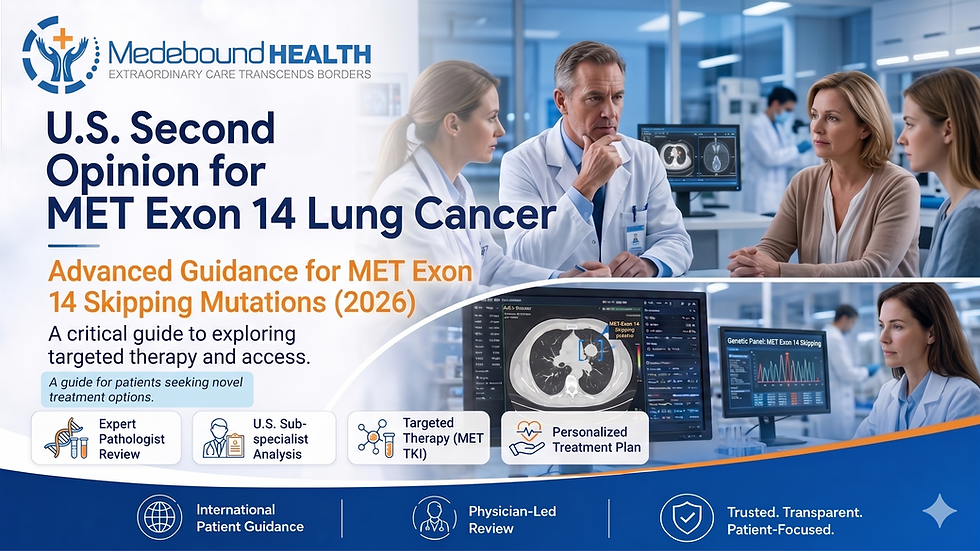
Getting a U.S. Second Opinion Without Traveling to the United States
For patients outside the United States — or those within the U.S. who cannot easily travel to a major cancer center — remote second opinions have become an increasingly practical and accepted option. Leading U.S. oncologists can review pathology reports, imaging studies, genomic testing results, and treatment histories without the patient physically being present.
This process typically involves:
Services that connect patients with U.S. cancer specialists — such as those offering a U.S. cancer second opinion — are designed to bridge this gap. They coordinate with U.S. oncologists who specialize in rare lung cancer mutations and manage the logistics of record transfer, translation if needed, and consultation scheduling. Medebound HEALTH, for example, facilitates access to U.S. cancer specialists for patients who face barriers to traveling directly to a U.S. cancer center. Medebound HEALTH is not affiliated with any specific hospital or institution.
How Medebound HEALTH Connects International Patients to Top U.S. Cancer Experts
Medebound HEALTH is a U.S.-based medical coordination service that facilitates second opinions from independent U.S.-licensed physicians affiliated with leading cancer centers such as MD Anderson, Mayo Clinic, Memorial Sloan Kettering and Johns Hopkins. Since 2016, the service has supported 3000+ international patients, primarily from Asia, seeking expert input before major oncology decisions.

Rated 4.6 ⭐⭐⭐⭐⭐ at Trustpilot
Medebound HEALTH's online testimonials. Learn More
What to Expect From Targeted Therapy: Real-World Considerations
If MET exon 14 targeted therapy is appropriate for you, understanding what treatment looks like in practice can help you plan more effectively.
Oral and at-home: Both capmatinib and tepotinib are pills taken once daily at home. There are no infusion appointments, no IV lines, and no chemotherapy suites involved.
Monitoring is still required: Regular blood tests and imaging scans are needed to assess treatment response and monitor for side effects, particularly fluid retention (edema).
Duration varies: Patients continue targeted therapy for as long as the drug is controlling the cancer and side effects are tolerable. Median duration of response has ranged from around 9 to 14 months in clinical trials, though some patients respond for much longer.
Resistance can develop: Over time, some tumors develop mechanisms to work around the MET inhibitor. This is a known challenge that researchers are actively addressing through next-generation inhibitors and combination strategies.
Access to drugs: Both capmatinib and tepotinib are approved in the U.S. and in several other countries. Access may vary by region. A U.S. specialist consultation can also help clarify whether expanded access or clinical trial participation is an option for patients in countries where these drugs are not yet available.
Conclusion: Precision Medicine Has Changed What Is Possible
MET exon 14 lung cancer is a specific, targetable subtype of NSCLC — and for patients who carry this mutation, the treatment options have never been more promising. FDA-approved oral targeted therapies now offer a viable, evidence-based alternative to traditional chemotherapy, with response rates and tolerability profiles that represent a genuine advance in care.
But accessing these options requires the right testing, the right expertise, and awareness that these treatments exist. For patients around the world whose local oncology teams may have limited experience with this rare mutation, a remote second opinion from a U.S. lung cancer specialist is not an extravagance — it is a practical step that can directly inform better treatment decisions.
If you or a family member has been diagnosed with NSCLC and have questions about molecular testing or targeted therapy options, exploring a U.S. cancer second opinion is a step worth taking — regardless of where in the world you are currently receiving care.

Disclaimer
We strive to maintain the accuracy and provide regular updates for the treatment information described in this article. However, treatment outcomes may vary between individuals. The information provided here is not intended as a diagnostic or treatment recommendation and should not replace the careful evaluation and advice of your attending physician. The service is independently operated by Medebound HEALTH and is not provided, partnered, or affiliated with any hospital center as an institution.


